Do You Really Need to Returf Your Lawn?
By Greener Lawn Care - 26 July 2026 - 10 min read
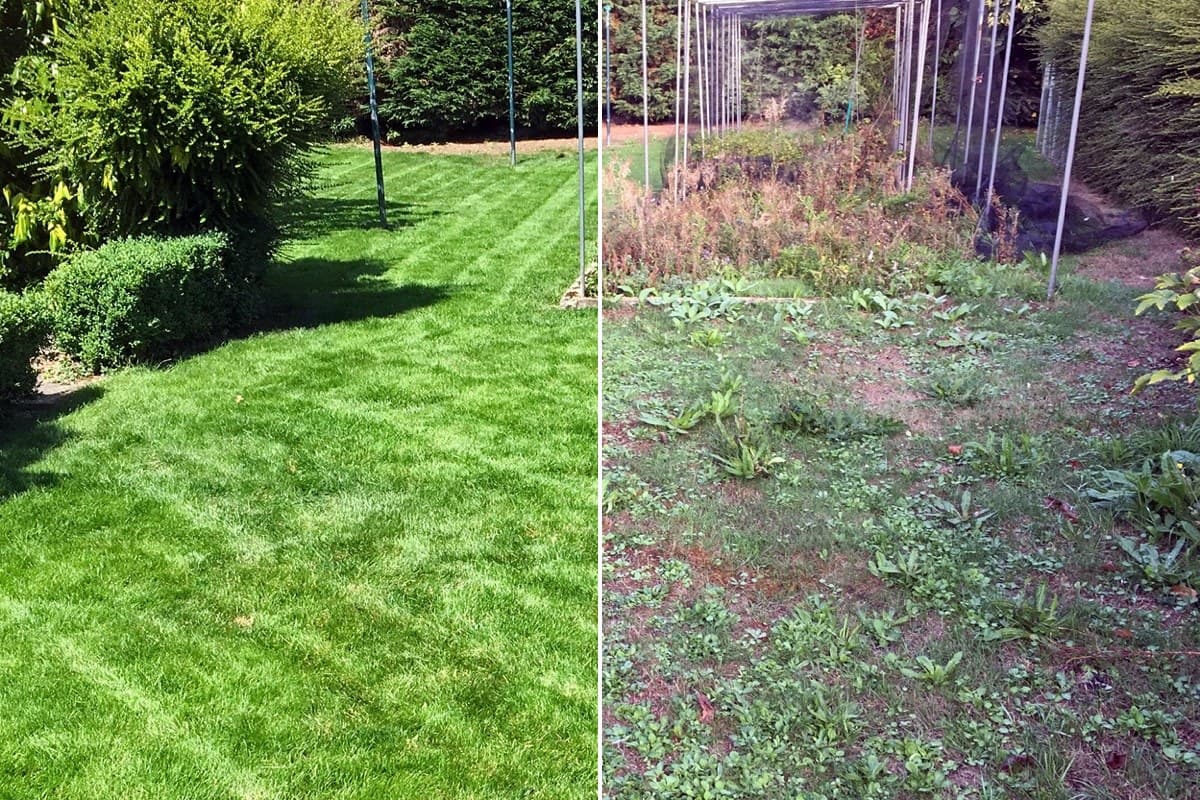
If you have looked at your lawn this summer and wondered whether it is beyond fixing, it is a fair question to ask. A lawn that has gone thin, mossy and brown does look finished. The surprise is how rarely it is. Most of the lawns we are asked to price up for replacement do not need replacing. They need the ground underneath sorting out, and that costs a fraction of what turf does.
Turf is a perfectly good product, and there are three situations further down this page where we will tell you to lay it rather than take any of our routes. But before you spend four figures on it, it is worth knowing what you would actually be buying, and what the alternatives cost.
The short answer
Returfing a lawn professionally costs £10 to £25 per square metre once you count stripping the old lawn, waste removal, ground preparation, turf and labour. A lawn renovation of the same lawn costs a fraction of that. Where the lawn genuinely is past saving, clearing it off and growing a new one from seed still comes in at around half the price of turf.
The reason renovation works is that a failing lawn is almost never a turf problem. It is a soil problem, and new turf laid on unchanged soil tends to run into the same trouble within a season or two.
The honest test: can your lawn be saved?
Forget how bad it looks. Look at what is actually growing there.
If there is decent grass under the mess, the lawn can be saved. Thin, mossy, compacted, patchy, full of weeds, brown after a dry August: all of that is recoverable. The grass that is there already has a root system, and thickening it up is far cheaper and faster than starting again. This covers most lawns, including plenty that look hopeless in high summer.
If the grass itself is the problem, it cannot. That means coarse, wiry species that stay coarse however well you feed them, or a weed population so established that selective treatment will not shift it. Sowing good grass seed into either of those is money wasted, because the plants already there outcompete every new seedling. That is when starting again becomes the cheaper answer, not the more expensive one.
The usual industry marker for needing a full renovation rather than simple overseeding is around 50 per cent moss or weeds. Note what that means: 50 per cent is where a renovation becomes necessary, not where turf does.
If you are trying to work out which side of that line your lawn falls on, the renovation versus returfing comparison walks through it properly, with costs for each route.
What returfing actually costs, and why
The turf itself is the cheap part, usually £2.40 to £7 per square metre. Almost all of the cost sits around it.
- Stripping and disposing of the old lawn. A turf cutter, then a lot of heavy waste to shift.
- Skip hire. £150 to £250, sometimes more on a bigger lawn.
- Topsoil where the ground is poor. £45 to £135 per cubic metre, and most gardens that need returfing need topsoil.
- Ground preparation and laying labour. £10 to £20 per square metre. A specialist turf layer covers only 30 to 35 square metres a day, so labour adds up fast.
All in, that is £10 to £25 per square metre. On a 200 square metre lawn, a fairly ordinary back garden, you are looking at £2,000 to £3,000 at the lower end of published figures.
Why turf on bad ground disappoints
Grass grows in soil, not on it.
When a lawn thins, goes mossy or dries to nothing, the cause is nearly always underneath: ground compacted so roots cannot push into it, a thatch layer holding water at the surface, or too little soil depth for anything to root deeply. Stripping the grass off and laying fresh turf on that same ground changes what you can see and none of what caused it.
The new turf looks immaculate for a season. Then it roots into the same shallow layer the old lawn lived in, and starts behaving exactly like the lawn it replaced. This is the most common reason people end up returfing twice, and it is why we would rather deal with the ground.
A renovation works the other way round. Scarifying takes out the thatch. Fracture-tine aeration heaves and breaks up the compacted layer so air and water can get down. Organic topdressing builds real soil depth. Then seed goes into ground that can actually support it. Same lawn, different soil.
When killing it off and starting again is right
Sometimes the grass really is the problem, and no amount of overseeding will fix it. For those lawns we clear the whole thing off and grow a new one from seed. We call it a full lawn restoration, and it runs over four visits across six to eight weeks.
We kill the old lawn off, then go back about two weeks later over anything that survived. Once it has all died back we scarify it right down to bare soil, work the surface, and fill and rake out the dips. Then organic topdressing goes down to build a seedbed, and we sow. Three to four weeks later we come back to see how it has germinated, seed anything thin, and give it its first feed.
Three things are worth knowing before you consider it.
Levelling is included, and this is the only job where it actually works. With the surface bare, dips and hollows can be filled and raked out. On a lawn you are keeping that is impossible: filling a hollow means burying the living grass in it, and only a thin layer of topdressing can go over established grass at a time, so dips can only be improved gradually over several seasons.
It uses a total weedkiller. One application across the whole lawn, which is the opposite of the selective treatment a renovation uses. We would rather say that plainly than dress it up. If you would rather it was not used, the old lawn can be lifted off mechanically instead, which costs more and creates a great deal more waste, but it is a genuine option.
Spring or early autumn only. Seed needs warm soil to germinate from bare ground, and the clearance needs the grass to be actively growing. That gives April to May, or late August to September, and never during a hosepipe ban, because bare soil dries out within hours.
A full restoration costs about half as much as returfing the same lawn, and you end up with a lawn grown in your own soil rather than turf laid on top of it.
When turf genuinely is the right call
We would rather send you to a turf layer than sell you the wrong job. There are three cases. Two are about time, and the third is about ground that will not hold seed still.
- You need a finished lawn by a set date. A house sale, a wedding, an event. Turf looks finished the day it goes down. A lawn grown from seed needs a full growing season to get there, and nothing speeds that up.
- It is outside the sowing window and you will not wait. Sowing runs in spring or early autumn, because seed needs warm soil. Turf can go down through most of the year. If it is November and you want green by Christmas, that is turf.
- It is a steep slope or a bank. Seed has to stay where you put it long enough to root, and on a steep bank heavy rain washes seed and dressing downhill before that happens. Turf is pegged down and holds from the day it goes on.
That is the whole list. Changing the levels, reshaping the garden or putting in a new patio is not on it. Groundworks is a real job, but once the ground is finished the surface can be sown just as easily as it can be turfed, and seed into properly prepared ground gives you a better lawn for less money. The turf is the part you are paying extra for, not the groundworks.
And if you do lay turf, ask what is in it. Budget turf tends to be dominated by ryegrass, chosen because it grows fast on the turf farm rather than because it lasts in a garden. We get called out to plenty of lawns that were turfed two or three years ago and have already thinned right back. Whatever goes down, the ground underneath still has to be dealt with first, or the new lawn goes the same way the old one did.
If any of those apply to your garden, we will say so at the survey rather than steering you towards a renovation.
Do not judge a lawn in a drought
This matters more than usual in 2026, with the hosepipe ban across the Anglian Water area since 11 July.
In a dry summer, grass protects itself by going dormant. It stops growing, browns off and waits. It looks completely finished. In most cases it is not, and it comes back on its own once rain returns and temperatures drop. Every year, lawns get stripped out and returfed in August that would have recovered by October on their own.
If your lawn has browned off in the heat, the honest advice is to wait for autumn and judge it then. Brown lawn after a heatwave: dead or dormant? covers how to tell the difference, including the tug test that settles it in about ten seconds.
What happens in the year after
Whichever route you take, the year afterwards decides how the lawn looks the summer after that.
New turf with no feeding, no aeration and no attention to moss goes the same way as the lawn it replaced, just more slowly. The same is true of a renovation or a restoration left to fend for itself. The work resets the lawn; regular treatment through the year is what holds it and keeps it improving.
Most customers have the work done once, then move onto a monthly plan from there. The Treatment Plan covers the year's feeds, weed and moss control, and a renovation is booked alongside it as a one-off, timed for spring or autumn. Every lawn benefits from one each year for the very best result.
If your lawn is patchy rather than past saving, how to fix bare patches in a lawn covers the smaller version of the same job.
Find out which one your lawn needs
We survey lawns across Essex for free. We measure it, look at what is actually growing there, and tell you honestly which route makes sense. Usually that is a renovation rather than anything drastic. If it turns out turf is the right answer, we will say so.
Want help with your lawn?
Book a free lawn survey and we'll take a look at your lawn. No obligation, honest advice.