
Services
New Build Lawn Renovation
For turf laid on compacted builder's soil
Pale, patchy grass a year or two after moving in? It's rarely your fault, and it's rarely the turf. Most new build lawns are laid over ground that machinery compacted during the build, with only a shallow layer of topsoil on top.
We renovate the ground underneath, not just the grass on top, so your lawn can finally establish properly. Across Colchester, Chelmsford, Witham and the new estates in between.
Why do new build lawns fail?
New build lawns usually fail because turf is laid over subsoil that heavy machinery compacted during construction, topped with a shallow layer of topsoil. Grass roots can't push into the hard ground beneath, so the lawn dries out quickly in summer, struggles in winter and thins within a year or two.
The Royal Horticultural Society recommends cultivating soil to a depth of 20-25cm before laying turf. On most new build plots, the ground below the turf was never cultivated at all: it was tracked over by diggers and dumpers for months, then dressed with just enough topsoil to lay turf on before completion day.
That's why new build lawns are usually the first on the street to go pale in a dry spell. With nowhere to root deeply, the grass lives in the top few centimetres of soil and loses moisture fast, while older, deeper-rooted lawns nearby stay green.
- Compacted subsoil - diggers, dumpers and scaffolding compress the ground for months before the garden is finished. Roots can't push into it
- A shallow layer of topsoil - turf is often laid on just enough topsoil to green the plot up for completion day, far less than a lawn needs to root deeply
- Buried brick, mortar and stone - debris left under the surface blocks roots and creates patches that never quite thrive
- Poor drainage - water can't soak through the compacted layer, so it sits on the surface in winter, encouraging moss, and runs off in summer
- Turf laid in a rush - often at the very end of the build, sometimes out of season, and rarely watered in properly
Related: Lawn Aeration → · Scarification & Overseeding → · Lawn Renovation → · Moss Control →
Signs your new build lawn has a ground problem
- Pale or straw-coloured grass in dry spells, while older lawns nearby stay green
- Bare patches where grass has never properly established
- Gaps between the original turf rolls that never knitted together
- Water sitting on the surface after rain
- Ground that feels rock hard in summer
- Bumps and dips that the mower scalps
- Stones, brick or mortar working up to the surface
- Moss taking over damp or shaded patches within the first year or two
If two or three of these sound familiar, feeding and mowing alone won't turn it around. The ground needs opening up so roots, water and nutrients can actually get in.
A new build lawn we renovated
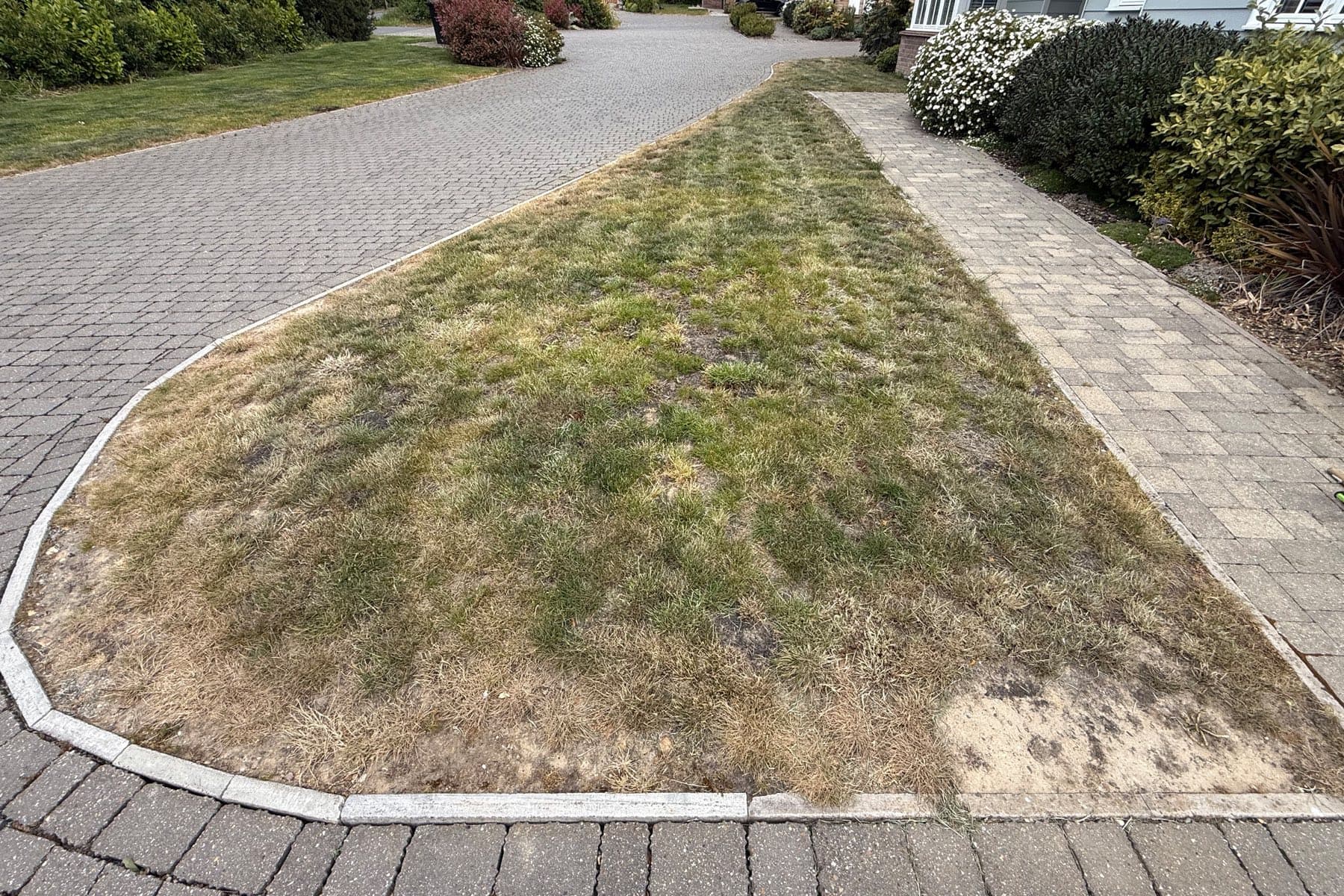
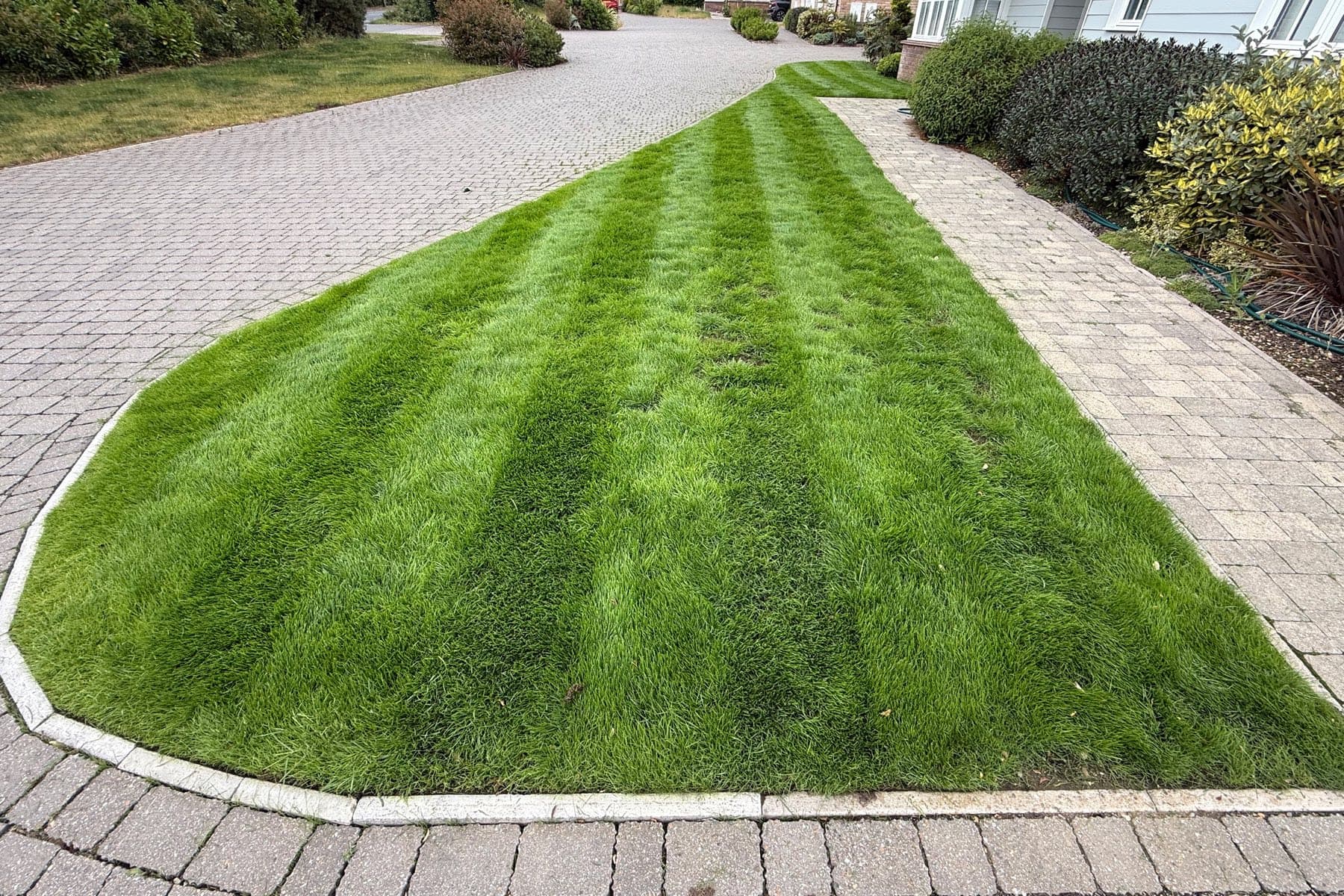
Bare new-build clay to thick striped lawn
Wickham Bishops, CM8 · Lawn Renovation
A four-year-old new-build lawn on heavy clay that had thinned right out. Wide patches of bare, dry soil showed through where the grass had given up, and the whole front lawn looked tired, hungry and uneven.
A thick, even lawn with deep colour and crisp mowing stripes, right out to the edges where there used to be bare soil.
Should you wait for the developer to fix it?
A fair question, and worth exploring first. Your builder is responsible for defects during the first two years, and if the garden was left in a genuinely poor state, raise it with them. New home warranties, however, focus on the structure of the house: garden turf sits outside the main ten year cover, and a lawn establishing poorly is usually classed as maintenance rather than a defect.
Even when a developer does come back, the usual remedy is fresh turf laid straight onto the same compacted ground. It looks right for a few months, then the same problems return, because the problem was never the turf.
Renovation deals with the ground itself: relieving the compaction, building soil depth and establishing grass that can root properly. That's why the results hold.
How we renovate a new build lawn
- Book a free lawn survey - We walk the lawn, check soil depth, compaction and drainage, and give you an honest assessment with a tailored quote that evening.
- Relieve the compaction - Aeration breaks into the compacted layer left by construction machinery so air and water can finally reach the roots.
- Scarify where needed - Scarification strips out thatch, weak growth and the dead seams between the original turf rolls so new seed makes proper contact with soil.
- Overseed with a hard-wearing blend - We overseed with seed matched to your lawn's conditions, including drought-tolerant blends for lawns that bake dry in summer.
- Topdress with organic compost - Organic compost topdressing builds real soil depth over the compacted base, levels out bumps and feeds the new grass as it establishes.
- Feed and aftercare - A feed to drive the new grass on, plus clear guidance on watering and the first mow so the results hold.
Renovation work is done in spring or autumn, when new seed establishes best. If you get in touch mid-season, we'll survey now and book the work for the right window.
Not sure if your lawn needs renovating?
Book a free survey and we'll tell you honestly, including if it doesn't.
Read how a free survey works · See pricing for your lawn size
Renovate once, then keep it that way
Most new build lawns need one properly done renovation to fix the ground, then steady care to stay thick and green. The typical path: renovate once, then The Treatment Plan maintains it from there.
New build estates we cover across Essex
New build estates are where we see these problems most, because every plot on the site was built the same way. If your lawn is struggling, chances are your neighbours' are too.
- Colchester - Stanway and the Northern Gateway estates
- Chelmsford - Beaulieu, Channels and the newer developments north of the city
- Witham - the growing estates along the A12 corridor
- Braintree - new developments on the edges of town
- Maldon - newer estates around the town and Heybridge
We also cover Tiptree, Halstead and the villages in between. Check your postcode here.
New build lawn questions
Why is my new build lawn patchy and thin?
Should I ask my developer to fix the lawn first?
Does a new build lawn need replacing, or can it be renovated?
How soon after moving in can the lawn be renovated?
How much does it cost to fix a new build lawn?
Ready to fix your new build lawn?
Book a free survey and we'll assess the ground honestly. You'll get a clear recommendation and a tailored quote that evening, yours to keep whether you sign up or not.
Not ready to book? Read how a free survey works · Check if we cover your area · See pricing
We fix the ground once. The plan keeps the lawn healthy from there.