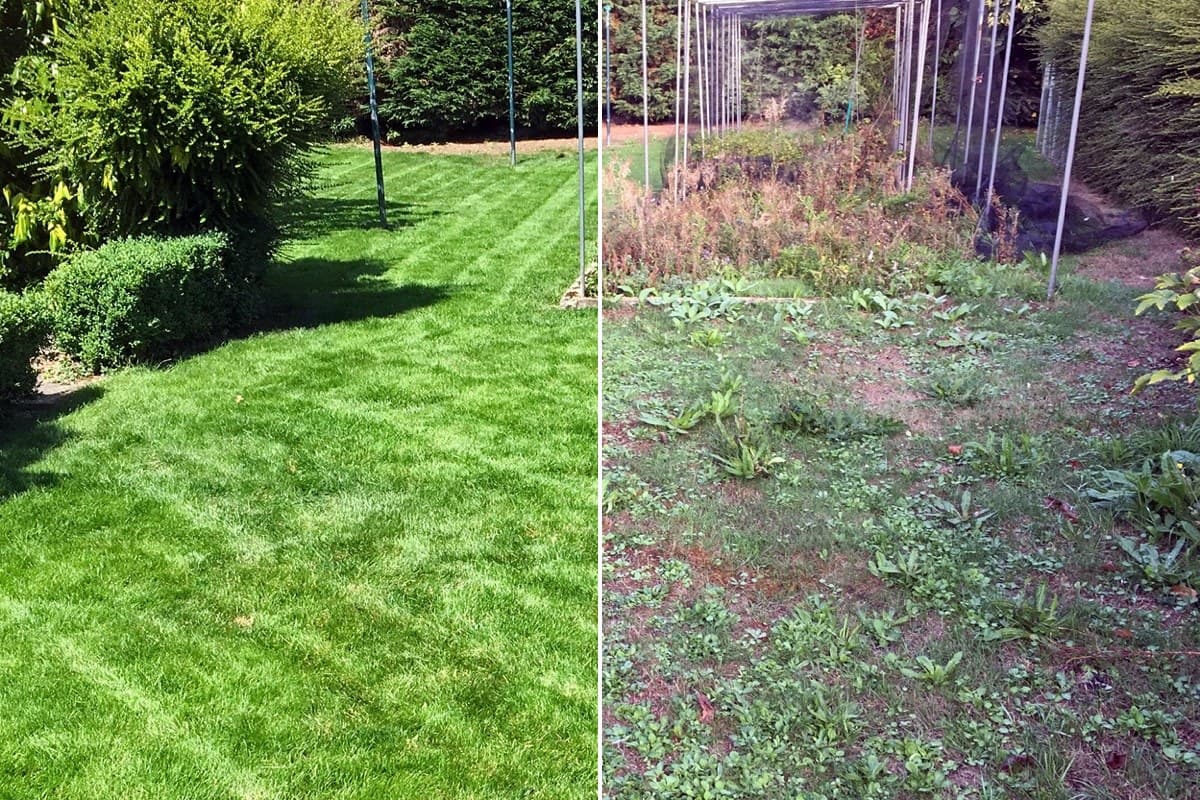
5 Signs Your Lawn Needs Professional Help
By Greener Lawn Care - 31 July 2026 - 9 min read
I make my living treating lawns, so you would expect me to say every lawn needs a professional. It does not: most lawn care is mowing, watering and feeding, and plenty of people do all three perfectly well themselves. But a handful of problems keep coming back however much effort you put in, and they usually mean something is wrong beneath the surface. Here are the five I see most often in Colchester gardens, each with what you can still try yourself before calling anyone in.
The short answer
The problems that genuinely need professional help share one pattern: they return every year no matter what you buy to fight them. Moss that reappears every winter, sponginess underfoot, water pooling in winter on ground that bakes solid in summer, weeds that shrug off treatment, and grass that stays thin however much you feed it all point to underlying causes, not surface symptoms. Those causes, usually compaction, thatch, or the wrong product at the wrong time, need a proper diagnosis and often machinery rather than another bottle from the garden centre.
Sign 1: The moss comes back every winter, whatever you treat it with
Moss killer does exactly what it says: it kills moss. It does not change the reason the moss was there. Moss moves into ground where grass is already struggling, because of shade, compaction, poor drainage, or turf so thin there is nothing to compete with it. Kill the moss without fixing those conditions and you have simply cleared the site for next winter's crop.
If you have treated two or three winters running and the moss returns on schedule every November, the product is not failing: the diagnosis is missing. Persistent moss is almost never really a moss problem: it is a drainage, compaction, or thin-turf problem showing itself as moss.
What you can still try yourself
Treat in autumn or early spring, wait 10-14 days for the moss to die, rake out the dead material, and overseed the gaps rather than leaving bare soil. Raise your mowing height to 35mm or more, and cut back whatever shade you reasonably can. The full method is in my moss removal guide. If you do all of that properly and the moss still returns, the cause is below the surface, which is where the next two signs come in.
Sign 2: The lawn feels spongy underfoot
Walk the lawn and notice what your feet tell you. Firm with a little spring is healthy. Soft and spongy, like a stale mattress, means thatch: a layer of dead stems, old roots and debris between the grass and the soil. A thin layer is normal. Past about a centimetre, it works against the lawn: rain and feed sit in it instead of reaching the soil, roots grow up into it instead of down, and moss thinks it is wonderful.
Thatch does not rot away faster than the lawn adds to it, so it has to come out mechanically, with a scarifier that cuts vertical blades into the turf. That is a proper autumn job, September to mid-October, with early spring as the fallback window, and overseeding straight afterwards to fill the gaps.
What you can still try yourself
Cut a small wedge out of the lawn with a knife and measure the brown layer between the green growth and the soil. Under a centimetre, a vigorous going-over with a spring-tine rake in autumn is enough on a small lawn, though your arms will have opinions about it. Beyond that, you can hire an electric scarifier for a weekend: two passes at different angles, seed straight after, and only in the autumn or early spring windows so the lawn can recover. If the sponge is deep, the lawn is large, or you did all this last year and it is back already, that is when a professional scarification and overseeding earns its money.
Sign 3: Water pools in winter and the ground bakes solid in summer
These look like two different problems. They are the same one: compaction. Most of Essex sits on heavy clay, and clay compacts under nothing more dramatic than feet, rain and its own weight. Compacted soil has no air pockets, so water cannot soak in and roots cannot breathe. In winter that shows up as puddles that sit for days; in a summer like this one, as ground set like concrete and grass that browns off days before the neighbours'.
The fix is hollow-tine aeration: pulling thousands of small soil cores out of the lawn so air, water and roots can get back in. On clay it is the single most useful mechanical treatment there is, best done in autumn once the soil has some moisture back.
What you can still try yourself
On small problem areas, an ordinary garden fork genuinely helps. Drive it in 10cm or so, rock it gently, step along and repeat. It is slow but free, and for one puddle-prone patch it may be all you need. Keep traffic off the lawn when it is saturated, because wet clay compacts worst of all. A fork cannot relieve compaction across a whole lawn, though, and solid tines push heavy clay sideways rather than removing any, which is why the machine version pulls cores out instead.
Not sure which of these signs applies to your lawn? A free survey gives you the diagnosis, with no obligation to book anything afterwards. Book a free lawn survey
Sign 4: The weeds keep winning despite regular treatment
If you treat weeds every year and every year there are more of them, one of two things is wrong: the product or the timing. Selective lawn weedkillers only work on weeds that are actively growing, which in the UK means spring to early autumn. Applied in late autumn or winter, or onto a drought-stressed lawn in a heatwave, they achieve very little beyond stressing the grass. Timing is the most common reason I hear that "the weedkiller did not work".
The second problem is product choice. Not every weed responds to the same active ingredients, and a few common lawn weeds shrug off the standard all-rounder products entirely. The third, quieter problem: killing weeds in thin turf just opens gaps for the next generation. A thick, healthy lawn is the only permanent weed control there is.
What you can still try yourself
Hand-weed the deep-rooted offenders after a good soak, when the ground gives them up whole. Spot-treat the rest with a selective lawn weedkiller while they are growing strongly, follow the label exactly, and avoid mowing for a few days either side. Then feed the lawn, because a dense sward does more for weed numbers than any spray. If you are doing all of that and still losing ground each season, the missing piece is knowledge: which product for which weed at which moment. That is a fair thing to pay someone for.
Sign 5: The whole lawn is thin and tired, and feeding does not change it
Feed a healthy lawn and it thickens. Feed a worn-out one and it greens up for a fortnight, then goes back to looking exhausted. If that is your pattern, nutrition is not the problem. Usually it is old, tired grass varieties long past their best, often sitting on the thatch and compaction from signs 2 and 3, and no fertiliser changes what species the lawn is made of.
That lawn does not need another feed. It needs a renovation: scarify out the debris, aerate the soil, overseed heavily with modern hard-wearing cultivars, and feed the new grass properly as it establishes. Done in September, it transforms a lawn in six to eight weeks, and is nearly always quicker and less disruptive than the returfing people assume they need.
What you can still try yourself
Overseeding is genuinely DIY-able on a small lawn. In September, mow short, rake hard to expose soil, sow at the rate on the bag after calibrating on a small area first, and keep the surface moist with light morning watering until the seed is up. The honest caveat: seed only grows where it touches soil. If the lawn also has the spongy thatch from sign 2 or the concrete ground from sign 3, deal with those first, or most of your seed money will sit on the surface and feed the birds.
How we handle this at Greener
Every lawn I take on starts with a diagnosis, not a product. The free survey is me walking your lawn and working out which of the causes above actually applies, because treating the wrong one wastes your money and my time. If the honest answer is that a weekend of DIY will sort it, I will tell you that and leave you to it.
Where a lawn does need ongoing help, The Treatment Plan covers the year's treatments, and a lawn renovation is booked alongside it as a one-off, because that mechanical work is what stops moss, thatch and thin turf coming back each year. Weed control is minimal and spot-treated rather than blanket sprayed, timed for when the weeds are actively growing. Whether or not you ever book anything, the survey costs nothing: book a free lawn survey and at the very least you will know what you are dealing with.
Five signs, one pattern: a problem that returns every year is telling you the cause has not been found yet. Find the cause, and most lawns turn around within a single season.
Want help with your lawn?
Book a free lawn survey and we'll take a look at your lawn. No obligation, honest advice.