Watering Your Lawn in a Dry Summer: A UK Guide
By Greener Lawn Care - 10 July 2026 - 6 min read
Check the forecast in an Essex summer like this one and you will see a lot of sun icons and not much else. When there is genuinely no rain coming, the difference between a lawn that copes and a lawn that suffers is not how much water you throw at it. It is when and how you water. Most people get all three wrong, water more than I would, and end up with a weaker lawn for it.
The short answer
A lawn needs roughly 25mm of water a week in hot, dry weather to stay green, delivered as one or two deep soaks rather than a daily sprinkle. Water in the early morning, ideally before 9am, and never in the evening. If you cannot or do not want to water that much, an established lawn can simply be left to go dormant: brown, but alive, and back to green within a few weeks of rain.
First things first though: if a hosepipe ban applies to your address, hosepipes and sprinklers are off the table and the rules in our hosepipe ban guide take over. Everything below assumes you are allowed to water.
Deep and rare beats little and often
Grass roots grow towards water. Give the lawn a light splash every evening and the top 2cm of soil stays damp while everything below dries out, so the roots stay up in that shallow layer. The lawn becomes more drought-dependent, not less: hooked on the daily fix, and in real trouble the day you go on holiday.
One or two proper soaks a week does the opposite. Water gets down 10 to 15cm, the roots follow it, and the lawn becomes steadily harder to stress. On the heavy clay we have across most of Essex, deep watering has a second advantage: clay holds moisture well once it is wetted, so a good soak lasts. The catch is that baked clay sheds water at first, so if you see run-off, pause for ten minutes, let it soak, and go again.
How much is 25mm? Use a jam jar
Nobody can judge 25mm of water by eye, so do not try. Stand a straight-sided jar or empty tuna tin inside the sprinkler's coverage and time how long it takes to collect about 12mm (for a twice-a-week routine) or the full 25mm (for one weekly soak). That is your number. Most sprinklers on typical mains pressure take 30 to 60 minutes to deliver 12mm, which surprises people who have been doing ten-minute waterings and assuming the job was done.
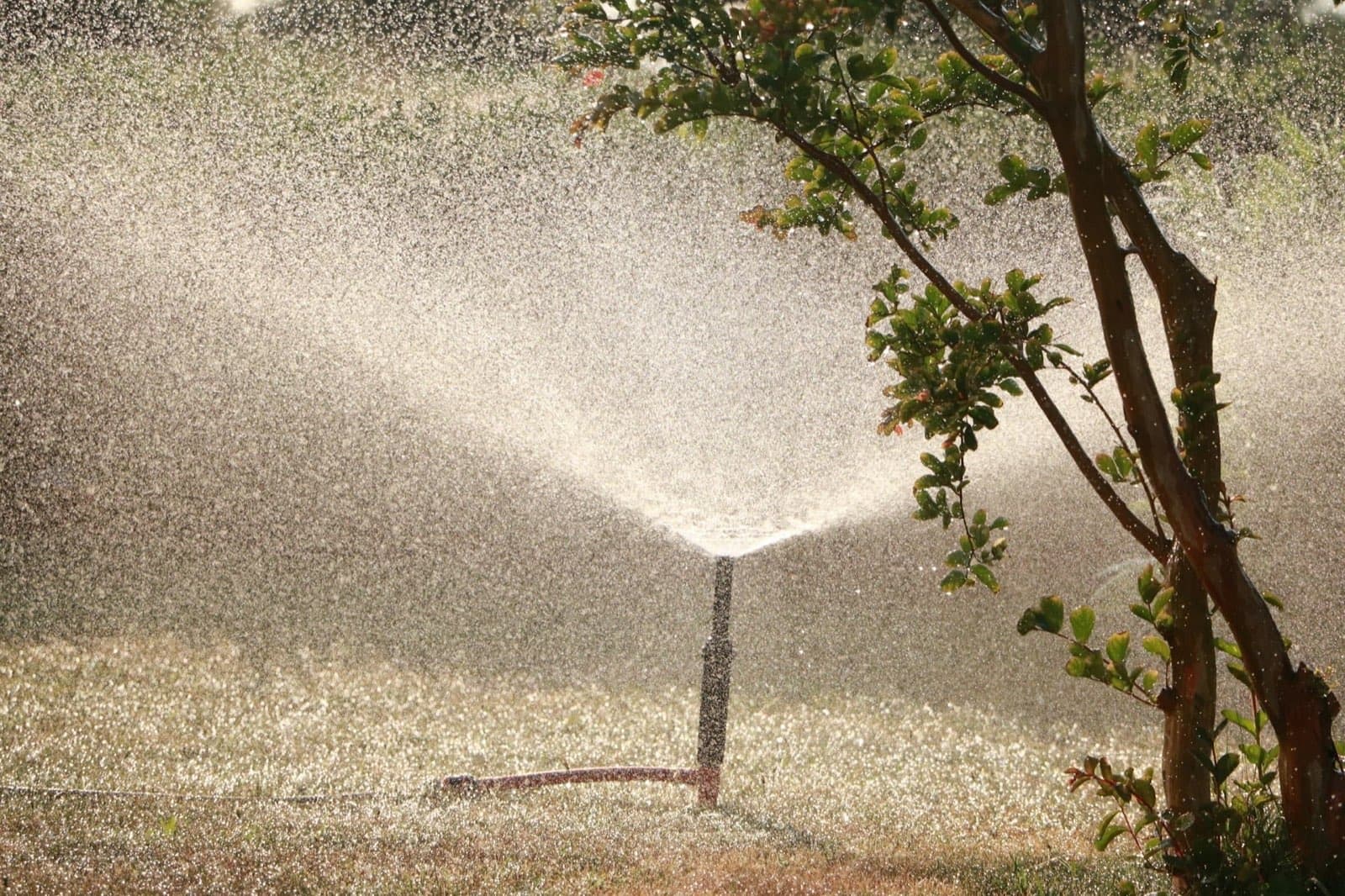
Do the jar test once and you can run on timings ever after. If you use a travelling sprinkler (the tractor type that pulls itself along the hose, like this one), coverage is more even across a big lawn and one pass is usually a decent soak. For medium lawns, an oscillating sprinkler and the jar test do the job fine.
Water in the morning. Never in the evening
Early morning, roughly 4am to 9am, is the right slot for every lawn, every time:
- Less evaporation. Cool air and still conditions mean the water goes into the soil, not the sky. Midday watering can lose a large share to evaporation before it lands.
- The lawn dries during the day. Grass that goes into the night wet is an open invitation to fungal disease, and warm humid nights are exactly when diseases like red thread take hold.
Evening watering feels sensible because it is cooler, and it is the single most common watering mistake I see. The water sits on the leaves all night and the lawn stays wet for eight hours plus. If mornings are impossible for you, a timer tap solves it for a few pounds: set it for 5am and go back to bed.
New lawns are the exception
Everything above applies to established lawns. Grass sown or turfed within the last few months plays by different rules, because the roots are still in the top few centimetres and cannot reach deep moisture:
- Newly seeded areas need the surface kept consistently moist until germination and through establishment: light watering daily (or even twice daily in a heatwave), always with a fine spray so the seed does not wash around.
- New turf needs enough water to soak through the turf and into the soil beneath, daily in hot weather for the first two to three weeks. Lift a corner to check it is actually getting through.
- Once the new grass is up, growing and has been mowed a few times, start stretching the intervals and deepening the soaks to push the roots down.
This is why watering is the make-or-break factor for summer-sown lawns, and why I renovate lawns in autumn and spring rather than fight July. If you are nursing new grass through this weather, it earns first claim on whatever watering you are able to do.
Thinking about rebuilding a tired lawn once the weather breaks? Autumn is the window, and surveys are free. Book a free lawn survey
If you decide not to water at all
Completely legitimate choice, and in a hosepipe ban it may be the only choice. An established lawn will go brown and dormant, and it will recover with the autumn rain. If you want to hedge, a single deep soak every three to four weeks keeps the crowns comfortably alive without chasing greenness. The full playbook for a browned-off lawn, including how to check it is dormant rather than dead, is in Brown lawn after a heatwave.
Either way, skip the feed and the weed treatments until the rain returns, mow high and rarely, and plan the comeback for September: aeration and overseeding with drought-tolerant grasses is what makes next summer easier, and for customers on The Treatment Plan it is booked alongside the plan as a one-off renovation.
The whole system in one line: deep soaks, early mornings, a jam jar to keep you honest, and no guilt whatsoever about letting an established lawn go brown.
Want help with your lawn?
Book a free lawn survey and we'll take a look at your lawn. No obligation, honest advice.